

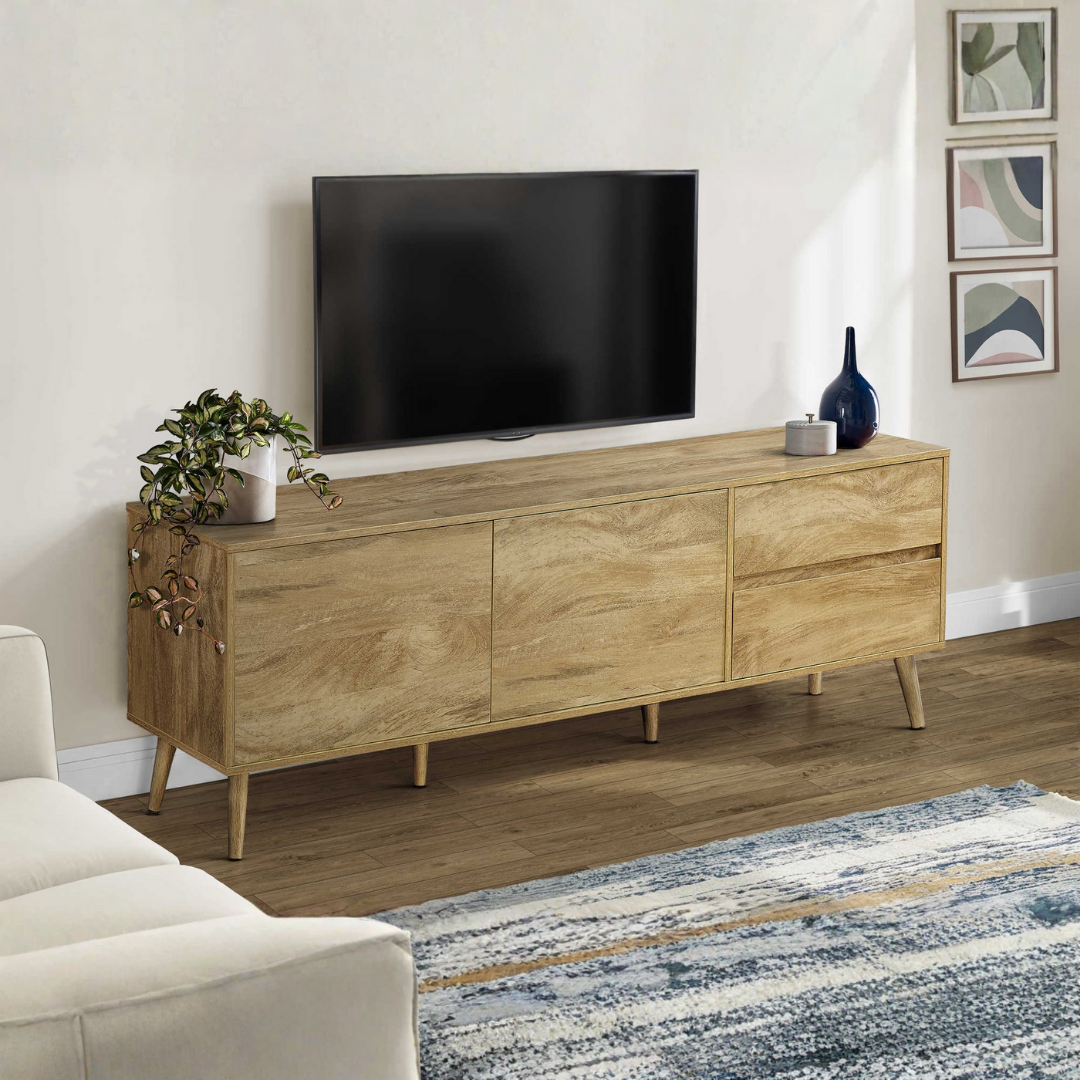
A basement living room is the perfect spot for hockey nights, movies, and games… until you realize the TV stand has to go down a tight staircase, navigate a landing, turn into a hallway, and then fit perfectly on the first try. When buying on liquidation, you want a new piece of furniture that comes in a box, is easy to handle, and assembles without improvisation.
The real challenge isn't just the style: it's access. A TV stand that's too long, too deep, or delivered in large, difficult-to-maneuver modules can become a headache in the basement. In this guide, you'll learn how to choose a basement TV stand based on what really matters: packaging, weight/sections, assembly, and critical dimensions (stairs, ceiling, clearances, depth).
And since you're shopping in Montreal, we'll give you concrete options for Montreal liquidation TV stands that meet specific needs: small staircase, packed media corner, large screen, closed storage, or quick assembly with tools included.
Ready to choose a TV stand that goes into your basement without complicating your life?
View available TV stands nowWhat you'll learn
- How to measure your staircase and hallway to avoid getting stuck with the wrong furniture.
- What to prioritize in the description: tools included, push-latch, sliding doors, cable management.
- Critical dimensions for a basement: depth, height, rear clearance, and circulation.
- What type of storage to choose depending on your setup (console, soundbar, router, games, etc.).
- Concrete liquidation solutions in Montreal, with direct links to the models.
Quick choices
- Small staircase / tight landing → Zyven 48 in
- Maximum storage for basement accessories → Torin 72 in (4 drawers)
- Large screen + signature mid-century look → Belvir 72 in
1) Before you buy: the 4 measurements that prevent unpleasant surprises in the basement
For a basement living room, the question isn't "does it fit on the wall?", but "does it go down and does it fit without snagging?". Take 5 minutes and note these four measurements: minimum staircase width (between railing and wall), headroom (ceiling/stringer), hallway width at the bottom, and turning radius at the landing (where you need to turn the furniture or box).
Then, compare these with the furniture's dimensions (length and depth especially). A depth of 15.25 to 16 inches is often easier to maneuver than a deeper piece, because you can hold it closer to your body and gain more degrees of rotation in turns. If you want to minimize risk, aim for a model delivered in a box with home assembly: you'll be carrying flat panels, not a bulky block.
A direct solution if you want a compact format that fits better down stairs and remains functional for a basement: a 48-inch unit with drawers and an open central shelf.

2) Easy-to-assemble TV stand: what to look for (and what to avoid) when it's for a basement
An easy-to-assemble TV stand isn't just about "it goes together." It's a piece of furniture where you know in advance: 1) if tools are included, 2) if the hardware is standard, 3) if the design allows for basement installation (floor not perfectly level, walls not always square, poorly placed outlets).
In descriptions, look for mentions like "hardware and tools included" and "cable management." Cable management in the basement makes the difference between a tidy TV corner and a nest of wires trailing on the floor (and getting snagged when you pass). Another practical detail: push-latch doors (handle-less) reduce the risk of snagging something in a narrow passage, and they maintain a smoother facade if your basement also serves as a game room.
Perfect solution if you want a large unit that assembles neatly with included tools, plus push-latch doors and cable holes for a clean setup.

Bonito Tip
Before bringing the box down, open it on the main floor, check the panels (without taking them out completely), then bring the pieces down in two trips. This reduces the risk of hitting a stair corner and keeps the hardware grouped together. If you want to complete your TV area, a coffee table with an easy-to-clean surface is often the most logical pairing in a basement.
3) "Basement" dimensions: depth, height, and clearances for your screen and devices
A basement often has two constraints: lower ceilings and tighter circulation. For visual comfort, you want the screen at a natural height when seated (not too high), and for practicality, you want to be able to access consoles, routers, set-top boxes, and soundbars without moving everything.
Three rules that avoid 90% of irritations: (1) depth around 15 to 16 inches to maintain comfortable passage; (2) closed storage if you want to hide power strips and accessories; (3) cable openings aligned with your wall outlets. A unit with multiple drawers is particularly effective in a basement because accessories accumulate quickly (controllers, headphones, batteries, cables, games).
Ideal solution if your basement serves as a media room and you want to "put everything away" without stacking: 4 drawers + open spaces in the center for devices.

| Basement Need | Dimension/Feature to Prioritize | Why it changes your daily life |
|---|---|---|
| Easy to bring down | Home assembly + shorter format (e.g., 48 in) | Less risk on stairs, easier to maneuver at landings |
| Console + decoder + router setup | Open shelves + cable management | Quick access, fewer visible wires, less trapped heat |
| Keep basement visually tidy | Closed storage (doors/drawers) | Hides power strips, controllers, and accessories, room looks tidier |
| Floor not perfectly level | Adjustable feet or stable base | Level furniture, doors/drawers close properly, stable screen |
| Large screen | 72 in and 75–80+ in compatibility depending on model | Balanced proportions, less risk of TV overhanging too much |
4) Sliding doors, drawers, or cabinets: choose according to your access and usage
In a basement, access is often lateral (you pass by one side of the furniture), or you have to navigate around a sectional sofa. In this context, sliding doors are a big advantage: you don't need forward clearance to open them. This is crucial when the furniture is close to a game table, an ottoman, or a walkway.
Drawers, on the other hand, are unbeatable for organization, but they require clearance in front. Closed cabinets are perfect for hiding things, but make sure they have cable openings so you don't pinch wires behind the doors. If you want a piece of furniture that adapts well to tight circulation, a console with sliding doors and open central shelves gives you the best of both worlds: easy access + clean look.
Direct solution if your basement has a narrow passage in front of the furniture: sliding doors + cable management, without doors opening into your way.

Which TV stand to choose depending on your situation
If your staircase is tight and you want to minimize handling → choose a compact format like the Zyven 48-inch: shorter, easier to turn at landings, and you get two drawers for accessories.
If your basement serves as a media room (games, TV, accessories) → choose the Torin 72-inch: its 4 drawers on metal glides give you real storage capacity, with open spaces in the center for devices.
If you want a clean facade and easy access even when it's tucked into a narrow passage → choose the Velon 72-inch: the sliding doors avoid clearance issues and maintain a neat look.
If you want a large "signature" piece that looks instantly finished → choose the Belvir 72-inch: drawers + push-latch doors + adjustable shelves, practical for daily use and visually solid.
If you want a large piece of furniture with texture and stability (basement floor sometimes uneven) → choose the Ravix 72-inch: adjustable feet and complete storage for a clean setup.


Frequently Asked Questions
What length of TV stand should I choose for a basement?
For a large wall and a 65–75 inch screen, a 60 to 72 inch stand generally provides balanced proportions. If basement access is complicated (tight landing, narrow hallway), a 48-inch is often easier to bring down, and you can compensate with storage elsewhere (e.g., coffee tables with storage or wall shelves).
Sliding doors or hinged doors in the basement?
If your furniture is in a passageway (near a sofa, ottoman, or game table), sliding doors are more practical because they don't require forward clearance to open. A model like the Velon directly solves this problem.
How to avoid cable clutter in a basement living room?
Prioritize furniture with cable management openings and open areas for devices that generate heat. Models like the Torin (openings + cubbies) or the Zelro (cable holes) help keep the back tidy from installation.
Can I have it delivered in Montreal?
Yes. Delivery is free within a 30 km radius on purchases of $199+. If you prefer to spread out payments, financing is available via Affirm (0% for 6 to 12 months) or RBC (0% for 6 months, or 24 to 36 months with interest).
For a basement living room, the best liquidation TV stand isn't just beautiful: it's transportable (in a box, home assembly), logical to install (cable management, suitable storage), and sized for your circulation. First choose based on access (stairs/landings), then based on your use (sliding doors, drawers, cabinets), then finalize with the width for your screen.
Visit our warehouse at 5570 rue Cartier or shop online now.
Want to sort out your basement TV area today?
Visit store to compare

Leave a comment
This site is protected by hCaptcha and the hCaptcha Privacy Policy and Terms of Service apply.