

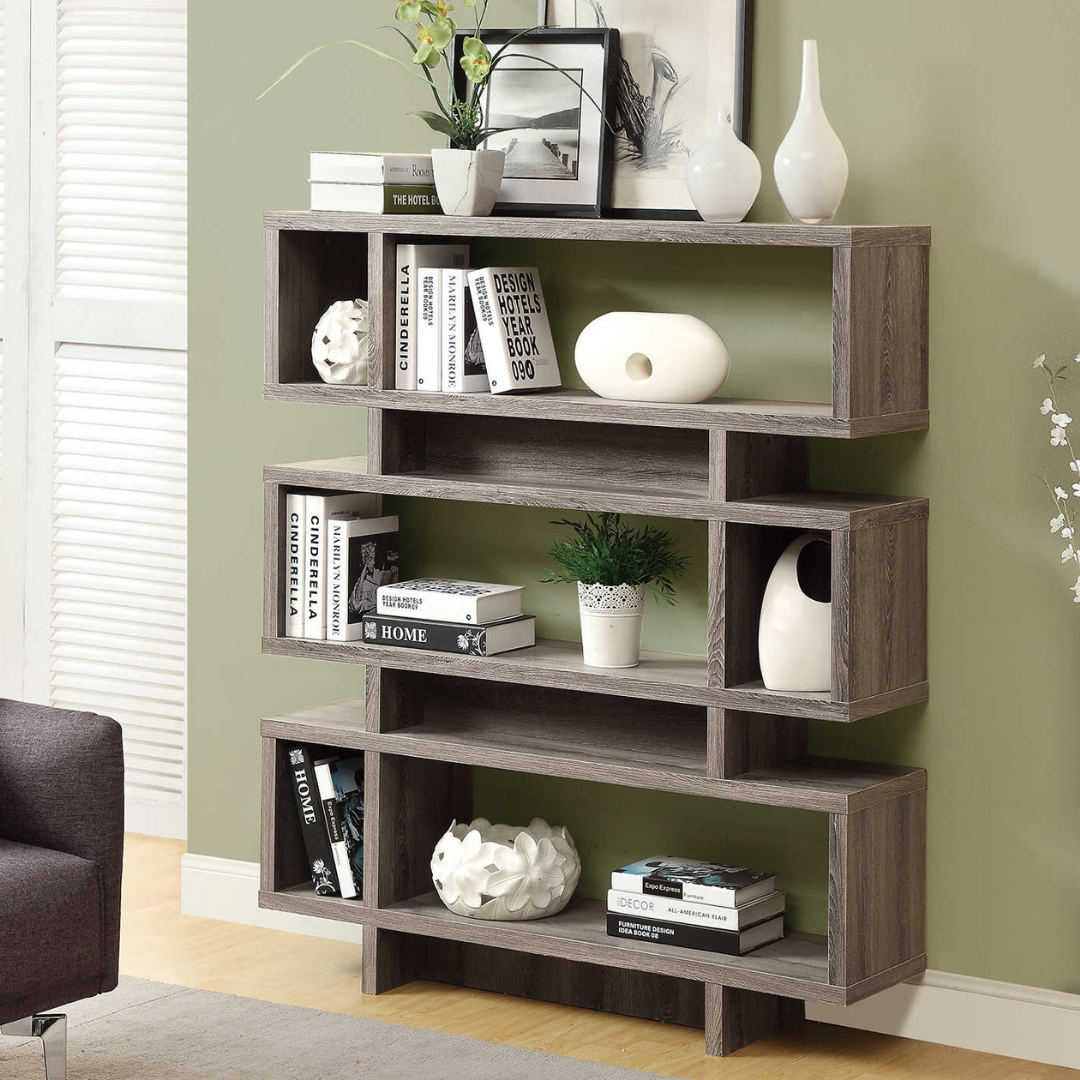
In an open space (condo, 4 1/2, 5 1/2, bright ground floor), the real challenge isn't "furnishing": it's defining zones without blocking light or making the room feel cluttered. A well-chosen bookcase can do exactly that: it creates a visual boundary between the living room, home office, and dining room, while maintaining an airy feel.
The secret is to think of the bookcase as a room divider rather than just storage. Dimensions, depth, stability, open sides, and even the finish (gloss white, tempered glass, black metal) completely change the perception of space. In this local guide, you'll see what to buy in bookcase liquidation Montreal to successfully achieve open space zoning without making the room feel heavy.
And since the decision often comes down to concrete details (height vs. view, depth vs. circulation, modules vs. airy lines), we'll direct you to specific models that meet real needs, available in our liquidation of new furniture in Montreal.
Ready to zone your space today with a light-permeable bookcase?
See available bookcases nowWhat you'll learn
- How to choose a room divider bookcase that defines zones without closing off the space.
- The dimensions that truly matter: depth, height, width, and their impact on circulation.
- What to prioritize to maintain light: open, glass, metal, and good volumes.
- Which models to buy in Montreal according to your needs (home office, living room, entryway, dining area).
Quick pick
- Small space → Ladderyx (48-inch ladder bookcase)
- Zoning without blocking light → Glasstone (60-inch glass bookcase)
- Assertive room divider → Stratura (55-inch display bookcase)
1) The right reflex for zoning an open space: choose "transparency" over storage
When you want to do open space zoning, the bookcase must first manage the sightline. If your goal is to separate the living room from the home office, you want a piece that "marks" the boundary, but doesn't create an opaque wall. In concrete terms, that means: open structure, light-reflecting materials, or a silhouette that allows the sides to breathe.
If you want a divider that maintains a light effect, a glass bookcase is a straightforward solution: it structures the space, but lets light and perspectives through. This is exactly the advantage of a model with tempered glass panels on the sides and back: you get a real presence, without the visual block.

2) Dimensions that avoid the "cluttered room" effect: depth and width above all
Most open spaces in Montreal have a sensitive point: circulation between the kitchen, dining room, and living room. A bookcase that is too deep will eat into your walkway and make you feel like you're going around furniture. For a room divider, aim for a reasonable depth: around 12 inches, you'll have enough space for books and decor, without turning zoning into an obstacle.
If you also want a piece that is sturdy (heavy books, binders, decorative objects), fixed shelves on solid supports become a real advantage: it reduces bending and keeps the bookcase stable over time. In this logic, a metal/wood bookcase with a robust frame is perfect for an open space where everything is visible: it provides a clear, structuring line, without appearing massive.

Bonito Tip
For a room divider, place the bookcase perpendicular to the wall (like a small partition) and leave at least 30 to 36 inches of passage on the most used side. You'll immediately feel the difference: the zone is defined, but circulation remains natural.
3) Height and stability: zoning without risking tipping (especially in a condo)
A tall bookcase can zone more effectively… but it must be chosen with stability in mind. In an open space, it's often placed in a thoroughfare (between the sofa and the table, near a desk, in a corner). If you want to maximize vertical storage without expanding the floor footprint, a 72-inch bookcase is ideal, especially with adjustable shelves to adapt your zones (books, baskets, decor).
To keep it safe and stable, one detail matters: the included anti-tip hardware, which allows it to be secured to the wall. This is the kind of feature that transforms a tall bookcase into a reliable everyday solution, especially if you have children or pets.

| Need in an open space | What to prioritize | Daily result |
|---|---|---|
| Zone without losing light | Glass panels / very open structure | The room remains bright, the space feels larger |
| Solid storage (books, binders) | Fixed shelves, metal frame, thick panels | Less bending, clean look, visible stability |
| Maximize an unused corner | Corner format, triangular footprint | You reclaim a dead angle without expanding the room |
| Create a clear living room/dining room separation | More generous width, divided compartments | The zone is clear, without building a wall |
4) The best "placements" for zoning: home office, living room, dining room (without blocking the view)
Zoning works even better when the bookcase is chosen for a specific location. Typical example: you want a home office in the living room, but you don't want your screen to be the first thing people see. A slim, vertical bookcase with open shelves creates a light barrier and provides a cleaner background.
In a small space, a ladder bookcase is ideal: it takes up little width, remains visually light, and its retaining edges help keep objects in place (practical when it's near a thoroughfare). It allows you to "sign" a zone (plants, books, frames) without closing off the room.

Which bookcase to choose depending on your situation
If you want to zone an open space without blocking light → choose a glass bookcase: it defines the zone but maintains an "airy and light" effect (perfect between living room and home office).
If you want a more assertive divider between living room and dining room → choose a wider display bookcase with compartments: you get a real visual "storage wall," but open.
If your issue is solidity for heavy books → choose a metal structure with fixed shelves and thick panels: this stabilizes the whole and remains neat even when loaded.
If you need large vertical storage without taking up your floor space → choose a 72-inch unit with adjustable shelves: you go up in height, you adapt the levels, and you maintain circulation.

Frequently Asked Questions
What depth should I choose for a room divider bookcase in an open space?
To avoid overwhelming the room and maintain good circulation, a depth of around 12 inches is often ideal: enough for books and decor, without encroaching on passages between the living room and dining room.
Is a glass bookcase stable enough for daily use?
Yes, if the structure is designed with tempered glass panels and fixed shelves. Glass allows light through (great for zoning), while adding rigidity to the overall unit.
How do I avoid a "wall" effect with a bookcase in a condo?
Choose an open structure (metal, ladder, glass) and avoid overly wide volumes. Also, place the bookcase to maintain a sightline to a window or light source.
Does Meubles Bonito deliver in Montreal?
Yes. Delivery is free within a 30 km radius on purchases of $199 or more. You can also pay with Affirm (0% for 6-12 months) or RBC (0% for 6 months, or 24-36 months with interest), depending on your plan.
In an open space, the right bookcase isn't just a storage unit: it's a design tool to create clear zones, maintain light, and make the room more logical for daily living. By focusing on transparency (glass), slenderness (ladder), solidity (metal), or height (72 inches), you can achieve clear zoning without making the overall space feel heavy.
Visit our warehouse at 5570 rue Cartier or shop online now.
Want to compare formats and get the right size for your open space?
Find your bookcase today

Leave a comment
This site is protected by hCaptcha and the hCaptcha Privacy Policy and Terms of Service apply.