

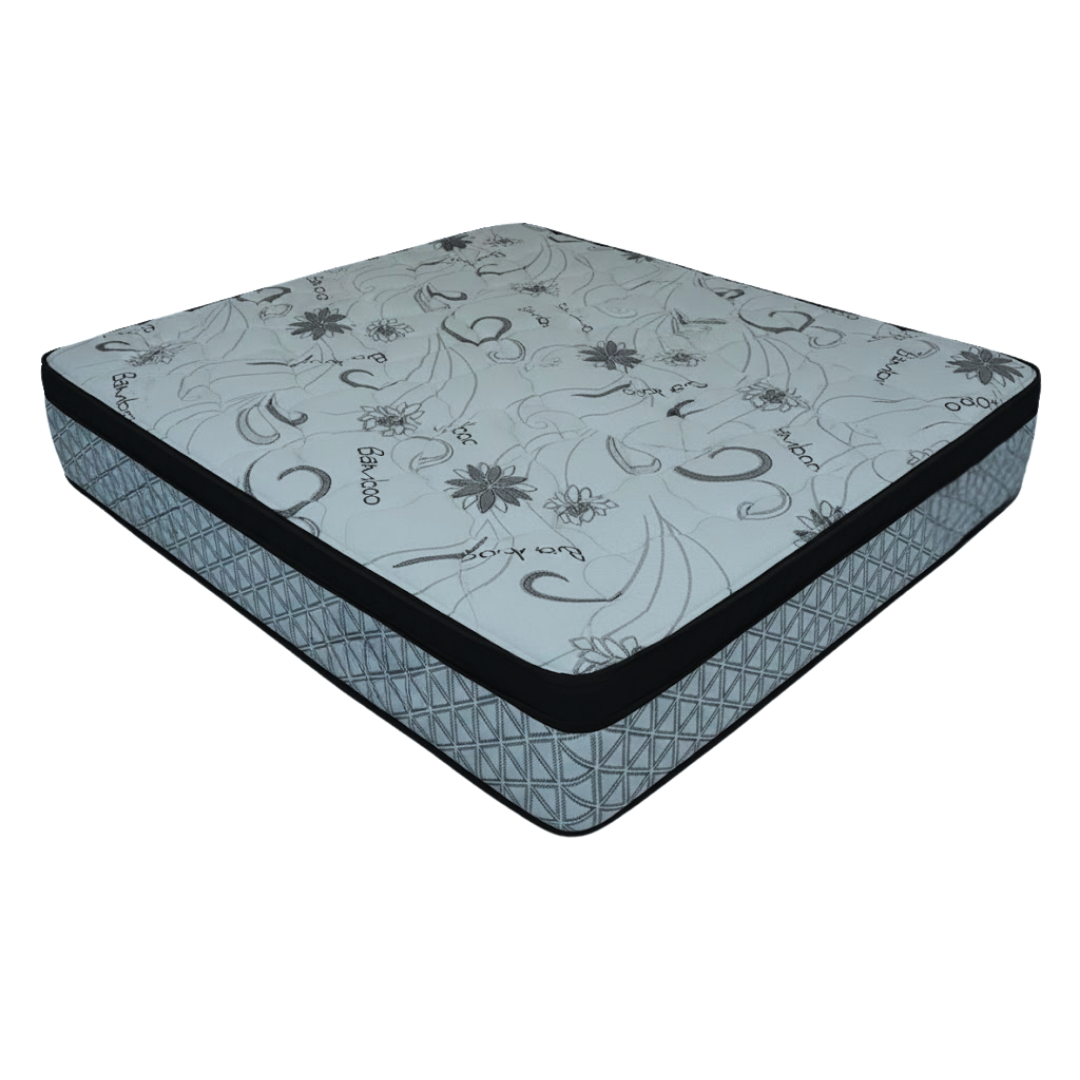
When you're shopping for a queen mattress on clearance in Montreal, the trap is to focus on the price and forget the one thing that changes everything: support. A queen mattress that's too soft can leave you with sagging hips; too firm, and you wake up with numb shoulders. The right deal is one that keeps your spine aligned and remains comfortable night after night.
The challenge in-store is that you have a few minutes to decide. In this article, you'll learn what to check quickly (support zones, alignment feel, mattress recovery) to choose a supportive queen mattress that makes sense, even on clearance. We'll also clarify how to spot a genuinely good clearance price—without sacrificing quality.
And if you want to buy now, we'll give you specific queen models (with their strengths) so you arrive with a clear idea of what you're looking for, instead of improvising on the showroom floor.
Ready to compare in-stock queen models right away?
View available queen mattresses nowWhat you'll learn
- The quick in-store test to validate support (in 3 positions, in less than 5 minutes)
- How to recognize "holding" support (recovery, stability, edge) vs deceptive comfort
- What to choose based on your needs: couples, sensitive backs, hot sleepers, firmer feel
- How to spot a real clearance deal in Montreal without ending up with an overly minimalist mattress
Quick picks
- Couple + zero motion transfer → Luxora (hybrid, pocket springs)
- Targeted support (shoulder/back/hip zones) → Aurex (3 zones, eurotop)
- Tight budget but more stable support → ComfortCore (HD foam, 8 in)
1) The quick support test: 3 checks to make on a queen mattress
If you want a supportive queen mattress and don't want to make a mistake in-store, forget the "I'll sit for 10 seconds and decide" approach. Instead, do this quick test, designed to tell you if the mattress maintains your alignment.
Check #1 — Alignment (on your side, 60 seconds)
Lie on your side, as you truly sleep. Good support means your shoulder sinks in just enough, but your hips don't "sag." If you feel a curve in your lower back, it's often too soft. If your shoulder pushes against the mattress and you tense up, it's often too firm.
Check #2 — Recovery (hand/forearm, 10 seconds)
Press your forearm into the center: the mattress should recover its shape smoothly, not remain "indented." Slow recovery can be fine if you want contouring, but if it feels like a "hole," you might struggle to move at night.
Check #3 — Edge stability (sitting on the edge, 15 seconds)
Sitting on the edge, your hips shouldn't slide outwards. A more stable edge means more usable surface area—practical if you sleep with a partner or often sit down to put on your socks.
For a quick clearance purchase, a high-density foam model with a medium-firm feel often gives a predictable result: consistent support, fewer "surprises" after a few weeks.

2) Support zones: how to know if your body is "held" in the right places
When we talk about support zones, we mean that the mattress reacts differently under your shoulders, back, and hips. In practice, this translates to a simple feeling: you lie down, you breathe, and your lower back doesn't strain. If you often wake up stiff, it's rarely "just age"; it's often poorly adapted support.
On clearance, you might find mattresses that look thick and plush but lack the internal structure to maintain alignment. One way to reduce the risk: aim for a model that clearly advertises a zoned system or a support architecture designed for alignment.
If you want a "balanced" feel (neither a board nor a cloud), with support that works harder under the heavier parts of your body, a zoned hybrid is a direct solution: you get the stability of springs and a softer top comfort layer.

Bonito Tip
In store, ask yourself: "Does my pelvis stay level with my rib cage when I'm on my side?" If the answer is no, the price isn't a deal—it's a compromise you'll pay for with your sleep. To see compatible foundations, also check out queen beds if your current frame is soft or unstable.
3) Foam vs. springs: which type offers the best support at the best price?
For a clearance queen mattress in Montreal, the best "smart budget" choice depends on what bothers you most at night.
You want consistent, predictable support: High-density foam in a medium-firm feel is often the most direct route. You get a stable surface that aids alignment, especially if you sleep on your back or change positions frequently.
You sleep with a partner and want less motion transfer: Pocket springs are a big advantage because each spring works more independently. Result: less motion transfer and a more "responsive" feel when you move.
You sleep hot: Hybrids (springs + comfort layers) generally breathe better, and some surface fabrics are designed to help with temperature regulation.
If your main need is: "I want a queen that provides good support, especially for two, and I want it to feel stable on the edges," a medium-firm hybrid with pocket springs is a very solid solution.

| Actual Need | What you should feel during the test | Recommended Queen Solution |
|---|---|---|
| Stable support, quick purchase, tight budget | Easy alignment + smooth recovery | ComfortCore (HD foam, medium-firm) |
| More "guided" alignment (shoulders/back/hips) | Pelvis doesn't sink on its side | Aurex (hybrid, 3 zones) |
| Couple: less motion transfer | Stability when the other moves + good edge support | Luxora (pocket coils, medium firm) |
| Hot sleeper | Surface that doesn't "stick" + air circulation | Titania (firm hybrid, cooling surface) |
4) Spotting a real clearance deal (without sacrificing quality)
A good queen mattress price on clearance isn't just about "the lowest amount." It's a mattress that provides a level of support consistent with your body type and maintains its shape. Here's how to spot a real deal quickly.
Clue #1 — Useful thickness, not just decorative
A more generous thickness can help, but only if the support base is solid (high-density foam or well-structured springs). A well-built 8 to 11 inches can be more satisfying than a very thick one that sags.
Clue #2 — Edge and usable surface
If you sleep with a partner on a queen, the edge matters. A firm foam encasement or edge reinforcement gives you more actual space, especially if one of you sleeps close to the edge.
Clue #3 — Your usage in 6 months
If it's for a master bedroom, you want support that "holds" when you sleep 300 nights/year. If it's for a guest room or rental property, you can aim for a thinner model, but one that remains stable and easy to live with.
For an "immediate" purchase with a strong focus on support, a firm hybrid with a cooling surface is perfect if you want to avoid heat retention and keep your spine well-aligned, especially on your back.

Which queen mattress to choose based on your situation
If you want reliable support at the best cost → choose the ComfortCore, ideal thanks to its high-density foam and medium-firm feel that aids alignment without a "plank" sensation.
If you want smarter support (zones) to prevent hips from sagging → choose the Aurex, perfect because its three-zone support targets shoulders/back/hips for more natural alignment.
If you sleep with a partner and want to reduce motion transfer → choose the Luxora, ideal thanks to its pocket springs (609 pocket coils) which better isolate motion and maintain good stability.
If you sleep hot and want firm support without losing surface comfort → choose the Titania, perfect thanks to its cooling quilted surface and 5-zone support that maintains spinal alignment.
If you want a more conforming feel (pressure relief for shoulders/hips) without sinking too much → choose the Gelora, ideal thanks to its cooling gel memory foam and high-density foam core that maintains durable support.
And if you're also changing your setup, make sure your frame is up to par: a good mattress on an unstable base loses some of its support. You can complement it with a model from the queen beds collection.


Frequently Asked Questions
How can I tell in 2 minutes if a queen mattress truly supports my lower back?
Lie on your back, then slide a hand under your lower back. You want light, even contact: if your hand passes too easily, your pelvis is sinking; if you can barely slide it, it's too rigid for you. Repeat the test on your side: your hips shouldn't "sag."
Is a hybrid mattress always better for support?
No. A hybrid can provide excellent support thanks to springs and ventilation, but a well-chosen high-density foam (e.g., medium-firm) can also be very stable. The right choice depends on your needs: couple (motion transfer), heat, or a firmer feel.
Which model should I choose if I want to adjust firmness over time?
The CoreFlip is made for that: it's reversible with two feels (one side medium-firm with a pillow top, the other extra-firm). This is practical if your preferences change or if you want a firmer option when your back is more sensitive.
Is delivery available in Montreal and can I finance?
Yes: delivery is free within a 30 km radius on purchases of $199+. For payment, you can finance with Affirm at 0% for 6-12 months, or with RBC at 0% for 6 months (24-36 months available with interest).
A queen mattress on clearance in Montreal can be an excellent purchase, provided you properly validate the support: side alignment, recovery, edge stability. By arriving with a clear plan, you avoid the deceptive comfort of the first few seconds and choose a mattress that works for your spine, night after night.
Visit our warehouse at 5570 rue Cartier or shop online now.
Do you want a queen with the right support today, while stock lasts?
Go to in-stock queen mattresses now

Leave a comment
This site is protected by hCaptcha and the hCaptcha Privacy Policy and Terms of Service apply.