

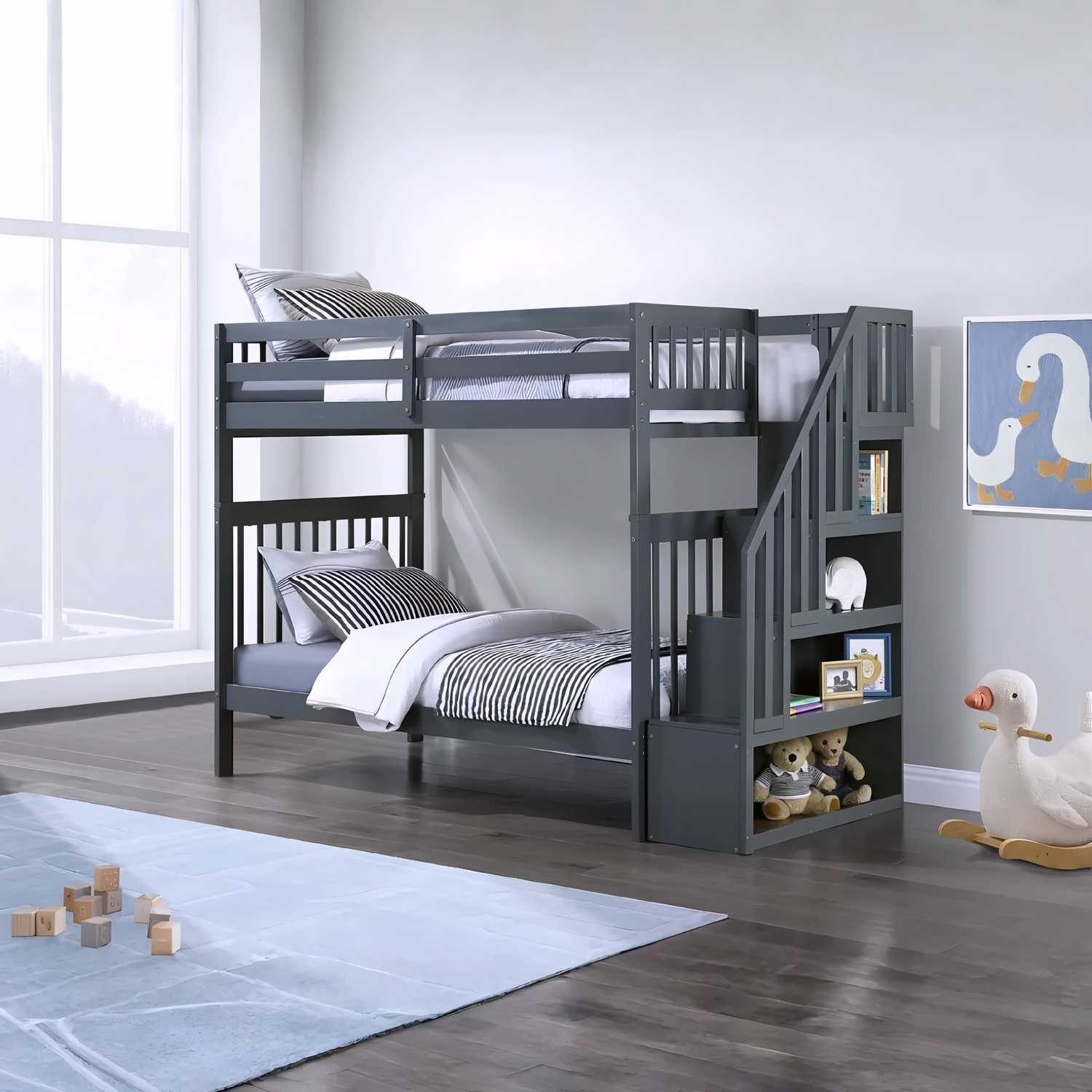
In a shared bedroom, the bunk bed quickly becomes the center of the room… and sometimes the source of complaints. A bed that moves, creaks with every change in position, or feels less stable as children grow can ultimately disturb sleep (and your patience).
The good news: a stable bunk bed can be chosen with very specific criteria. The bad news: if you only rely on looks, you risk ending up with a creaky bunk bed because the structure, anchor points, or access to the top bunk are not designed for daily use.
In this "problem-solution" guide, we review what to check to buy a bunk bed in Montreal that remains solid year after year — and we direct you to in-stock models that meet specific needs (small spaces, growing children, integrated storage, safer stairs, etc.).
Want to solve the problem now and compare in-stock structures?
View available bunk beds nowWhat you will learn
- Why a bunk bed moves or creaks (and how to avoid it from the purchase).
- Stability criteria to check: materials, dimensions, weight capacity, anchors.
- When to choose a ladder vs. stairs (and the impact on rigidity).
- Which models are best suited for a shared room in Montreal based on your space and children's age.
Quick choice
- Small space → Borra – Twin/Twin Bunk Bed – Black Metal
- Integrated storage → Dorsen – Twin/Full Bunk Bed – White Wood
- Maximum comfort (wider bottom) → Malvik – Twin/Full Bunk Bed – Grey Solid Wood
1) Why a bunk bed creaks (and what it says about the structure)
A creak is rarely "just a noise." In most shared bedrooms, it comes from a combination of micro-movements in the joints, friction between parts (metal-on-metal or wood-on-wood), or insufficient rigidity as children's weight and size increase. The more play there is in the structure, the more noise appears… especially at night when everything is quiet.
What you want is a structure that limits these micro-movements: a rigid frame, solid assembly points, and uniform mattress support (slats included) to prevent the mattress from "working" and amplifying sounds. And if the room is small, a well-proportioned compact model also helps: less leverage, less twisting.
A direct solution for a small space where you want a clean and robust structure: the Borra in tubular steel. It is designed to maximize floor space, with slats included and a 250 lb capacity per bunk, suitable for both children and teenagers.

2) The 4 stability criteria to check before buying
When you're shopping for a stable bunk bed in Montreal, keep these 4 points as a checklist. They give you a quick assessment of actual rigidity, not just appearance.
1) Materials and frame "mass." Tubular metal can be very strong (and practical in a small size), while solid wood/veneers that are well-assembled often give a more "solid" feel and better dampen certain vibrations.
2) Dimensions and proportions. A taller and longer bed increases leverage: if the structure is not well designed, this amplifies movements. For a shared room, compact, well-balanced dimensions make a real difference.
3) Weight capacity per bunk. This is a concrete indicator. As children grow, perceived stability largely depends on the supported weight. Several models here have a 250 lb capacity per level (and some go up to 420 lb for the bottom when it's a full size).
4) Included mattress support (slats). Included slats on both levels are a big plus: uniform support, fewer pressure points, and often less noise than an improvised setup.
If you want a wooden structure that remains solid and adapts to the evolving room, a model convertible into two beds is a smart solution: you retain the value of the furniture even when cohabitation changes. The Sander is perfect for this: solid wood/veneers, 250 lb capacity per bunk, included slats, and converts into two individual beds.

Bonito Tip
To reduce everyday creaking, aim for a structure with included slats and a clear weight capacity per bunk (e.g., 250 lb). Then, during assembly, follow the order of steps: "fully" tightening too early can create tension and play. Tighten progressively, then check after a few nights of use.
3) Ladder or stairs: access to the top changes stability (and routine)
In a shared room, access to the top bed is used multiple times a day. An integrated ladder can be very efficient in a small space, but stairs often provide a more "natural" ascent, especially as children grow. And there's another concrete advantage: well-integrated stairs can contribute to a more "grounded" feel of the structure, in addition to adding storage.
If you want to reduce movements related to going up/down and gain useful storage space (books, night light, small items), a bunk bed with stairs is ideal. The Nordik perfectly meets this need: reversible stairs (left/right depending on your room), integrated shelves, 250 lb capacity per bunk, and included slats.
To complete the setup of a shared bedroom, you can also look at the collection of twin beds if you eventually want to separate the configuration into two floor beds (practical when children become teenagers).

| Shared Room Need | What to Prioritize | Bonito Solution |
|---|---|---|
| Maximize floor space | Compact size + included slats + clear weight capacity | Borra Twin/Twin Black Metal |
| Evolutive furniture (when the room changes) | Structure convertible into two beds + solid wood/veneers | Sander Twin/Twin White |
| Safer access to top + storage | Reversible stairs + integrated shelves | Nordik Twin/Twin Grey Stairs |
| Older child (or adult) on bottom | Full size bottom + 420 lb capacity on bottom | Malvik Twin/Full Grey |
| Store bedding/clothes without adding a dresser | Integrated drawers + Twin/Full size | Dorsen Twin/Full White |
4) As children grow: weight capacity and bottom bed size
The classic scenario: at first, two little ones sleep well… then, a few years later, there's more movement, more creaking, and the bottom bunk becomes "the main bed" because that's where you read, rest, a parent sits for a story, etc. In this context, a twin/full size is a very logical solution: you keep the vertical footprint of a bunk bed, but you provide real comfort on the bottom.
Two details make an immediate difference in the feeling of solidity: (1) the weight capacity on the bottom (often higher for a full size), and (2) the quality of the support (included slats) that stabilizes the entire unit. The Malvik ticks these boxes, with a reversible staircase and integrated shelves that prevent adding furniture to an already full room.
If you want to plan for the future, also think "modularity": many families end up converting or supplementing with a floor bed. Keeping the twin bed collection in mind can help you build a room that adapts, rather than starting from scratch.

Which bunk bed to choose based on your situation
If you want to solve a creaking problem in a small space → choose the Borra, perfect if you want a compact structure with tubular steel, included slats, and 250 lb capacity per bunk to accommodate growth.
If you want an organized shared room → choose the Dorsen, ideal thanks to its integrated drawers that eliminate the need to add a storage unit to the room.
If you want safer access to the top bed → choose the Nordik, perfect if you want a reversible staircase with integrated shelves (practical for daily use, especially when going up/down often).
If you want maximum comfort on the bottom for an older child → choose the Malvik, ideal thanks to the twin/full size and 420 lb capacity on the lower bunk.
If your goal is to buy an evolutive structure → choose the Sander, perfect if you want to be able to separate into two beds when the shared room becomes two rooms or when needs change.
A quick logistical reminder: Meubles Bonito has 100% new inventory (1500+ products). Free delivery within 30 km on purchases of $199+, and you can also pay with Affirm (0% for 6-12 months) or RBC (0% for 6 months, or 24-36 months with interest) depending on your plan.


Frequently Asked Questions
How to prevent a bunk bed from creaking after a few months?
Choose a structure with included slats and a clear weight capacity per bunk, then tighten progressively during assembly. After a few nights, recheck the fasteners: that's often where micro-play appears.
Ladder or stairs: which is more stable for a shared room?
If access to the top is very frequent, stairs can give a more "grounded" and safer feeling, in addition to adding storage. A model like the Nordik has reversible stairs with integrated shelves, practical when the room is small.
What size to choose if one child is older or a parent often sits on the bottom bed?
A twin/full size is ideal: you keep the top bed as a twin, but you get a more comfortable bottom that is generally more "tolerant" of weight. Models like the Malvik offer up to 420 lb on the lower bunk.
Is a convertible bunk bed useful in real life?
Yes, especially in an apartment or when the shared room evolves. A convertible allows you to separate it into two beds when children want more independence. For example, the Sander is designed to transform into two individual beds.
A bunk bed that moves or creaks is almost always a signal: the structure is not adapted to the real use of a shared room. By prioritizing weight capacity, included slats, proportions, and the right type of access (ladder or stairs), you choose furniture that remains stable as children grow — and you get calmer nights.
Visit our warehouse at 5570 rue Cartier or shop online now.
Ready to compare structures and choose a stable model?
Visit our store to compare today

Leave a comment
This site is protected by hCaptcha and the hCaptcha Privacy Policy and Terms of Service apply.