

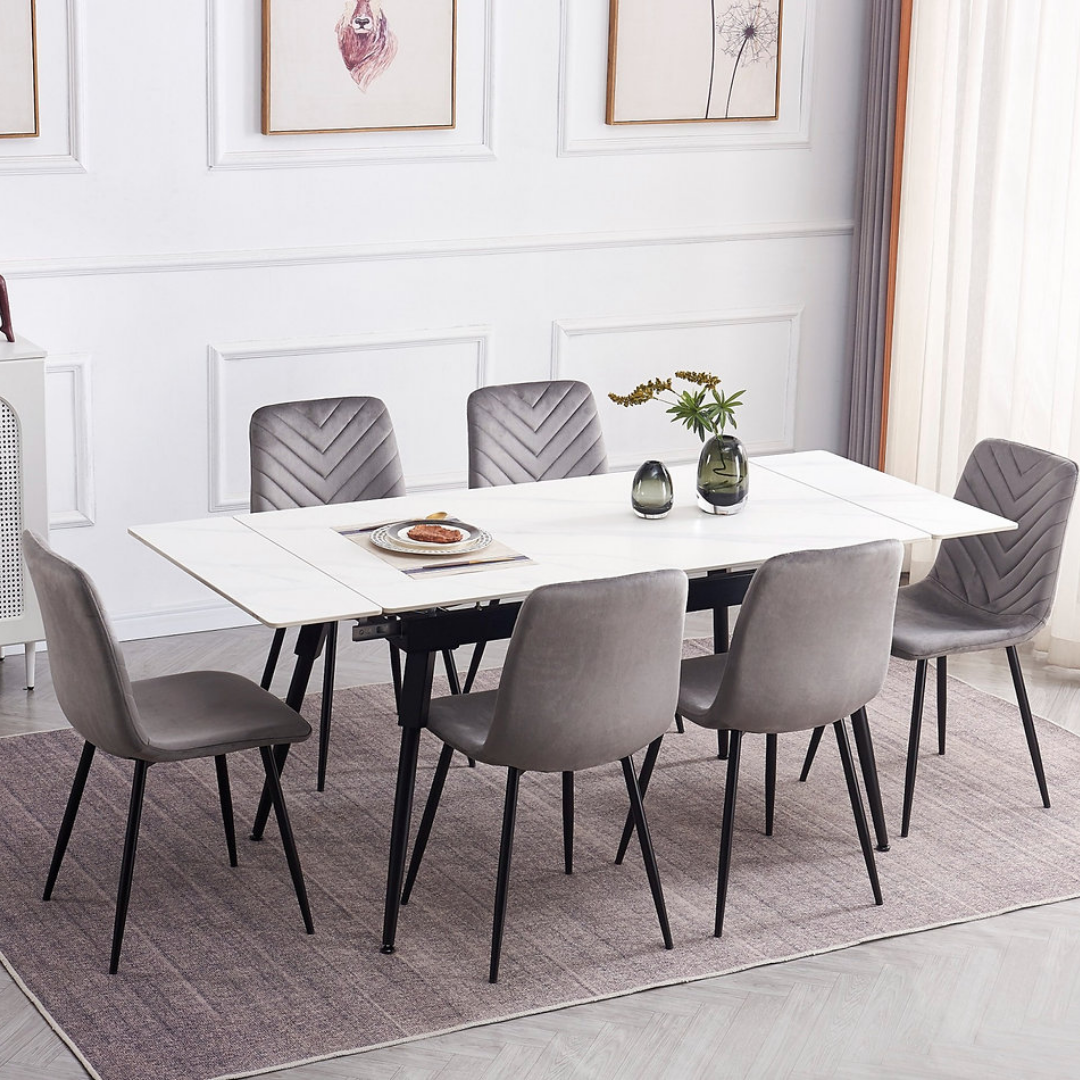
In a 5 1/2 apartment in Montreal, the dining room is almost never "just for entertaining." It's used for dinner, working, homework, folding laundry, chatting... and that's where traffic flow becomes the real buying criterion. A table that's too long, chairs that are too deep, or a base that blocks your legs, and your daily life starts to revolve around detours.
The right dining set for a 5 1/2 is one that allows you to move naturally between the kitchen, fridge, counter, and living room — even when someone is seated. In this guide, you'll learn how to calculate floor space, plan for chair clearance, and position the table according to your layout (open kitchen, hallway, dining nook).
And most importantly: we'll direct you to actual available sets, chosen as concrete solutions based on your space and habits. If you also want to complete your lunch area, you can take a look at bar stools to harmonize the entire open concept.
Want to optimize your traffic flow today?
View available sets nowWhat you'll learn
- How to measure the floor footprint of a dining set in a 5 1/2 apartment
- The minimum clearance needed behind chairs to maintain good traffic flow
- When to choose a round vs. rectangular table based on your layout (hallway, open kitchen, dining nook)
- How the base (pedestal, U-legs, X-legs) changes daily fluidity
- Specific sets in Montreal that meet these needs
Quick picks
- Small space → Valencia (round 3 pcs)
- Maximum leg room → Linear (round 5 pcs, open pedestal base)
- Extendable table for entertaining without blocking passage → Structa (extendable 55 to 75 in)
1) The "footprint + clearance" method: the key to effective dining room traffic flow
In a 5 1/2, you're not just buying a table: you're buying a pathway. To avoid the "obstacle in the middle" effect, measure in two steps.
Step A — the table's footprint: this is the actual floor area (length × width or diameter). It tells you if the table "fits."
Step B — chair clearance: this tells you if you can live around it. In practice, aim for:
• 24 in behind a chair to sit/stand (functional minimum).
• 30 to 36 in if it's a frequent pathway (to the fridge, hallway, patio door).
• 36 in+ if two people often cross paths.
If you want a quick rule: take the table's dimension and add about 48 to 72 in (24 to 36 in on each side) to estimate the "in-use" space.
Immediate solution for a tight dining nook: a compact round table, because it eliminates snagging corners and makes movement more natural.

2) Round vs. rectangular table in a 5 1/2: choose based on pathway, not looks
In an apartment, the table shape changes everything. The right choice depends on the traffic axis (where you pass most often) and the position of obstacles (counter, fridge, wall, sofa, door).
When a round table wins: if your main pathway cuts close to the dining area (open kitchen, hallway to bedrooms), a round table reduces shoulder bumps and "corners in the hips." It also makes it easier to get in and out of chairs because you can position yourself slightly diagonally.
When a rectangular table wins: if your dining room is "long" (corridor style) and you can place one long side against the wall or align the table with an island, a rectangular table optimizes the surface without widening the hallway.
Round solution designed for traffic flow: an open pedestal base. You don't have feet at the corners to block your legs, and you can reposition a chair without fighting with the structure.

Bonito Tip
Before buying, mark the table's shape on the floor with painter's tape (diameter or rectangle), then add a second line 24–30 inches around. Walk through the space as you normally would: fridge → sink → table → sofa. If you have to turn sideways, you've found your true bottleneck.
3) The detail that changes everything: the base and chair depth (this is where traffic flow gets lost)
Two sets can have the same table length but "live" completely differently. In a 5 1/2, it's often the base and chair depth that make the difference.
U-base / open structure: this allows feet to be placed naturally and facilitates movement between two chairs. This is especially useful if you use the table daily and frequently push chairs back.
Deeper upholstered chairs: comfortable, yes — but they require more space behind them. If your table is close to a wall or counter, an overly deep chair can turn a pathway into a dead end.
Solution for a 5 1/2 where you want to maintain stable traffic flow even when chairs are in use: a compact rectangular table with open lines and easy-to-slide chairs.

4) Placement in a 5 1/2: three scenarios to avoid bottlenecks (and what to buy)
Ideal placement depends on your layout. Here are three typical Montreal scenarios, with a product solution that addresses the traffic flow problem.
Scenario A — open kitchen + fridge/sink pathway
Your path cuts close to the table. Priority: round trajectories and maintain visual airiness. A glass table also helps because it allows light to pass through, making the space feel less "full."
Solution: a 10 mm tempered glass round table. It's perfect if you want to maximize the impression of space because the transparency visually lightens the dining area, and the round shape reduces snags in a frequent pathway.

5) Entertaining in a 5 1/2 without sacrificing traffic flow: the extendable table is your best lever
In a 5 1/2, the "ideal" everyday table is not necessarily the "ideal" table when you're entertaining. If you buy too large to be ready at all times, you pay the price every day: chairs blocking, detours around the table, a feeling of a cramped room.
The most logical solution is an extendable table: compact Monday to Friday, longer when you have guests. The key point for traffic flow is the mechanism: you want to be able to extend it without moving the whole room, and quickly return to compact mode.
Solution: an extendable sintered stone set (stain/heat/scratch resistant according to the description), perfect if you want a solid surface for everyday meals, but with the flexibility to open the table when guests arrive.

| Need in a 5 1/2 | Shape / feature to prioritize | Bonito Furniture Solution |
|---|---|---|
| Very tight dining nook (2–3 people) | Compact round table, easy maintenance | Valencia 3 pcs round 32 in |
| Frequent passage near the table (open kitchen) | Round + pedestal base + light visual effect | Laurent round 44 in tempered glass |
| Daily comfort + leg room | Open pedestal base, comfortable chairs | Linear round 48 in |
| Compact rectangular for long room | Open lines, easy-to-slide chairs | Vela 47.25 in |
| Entertaining occasionally without blocking space daily | Extendable table (compact closed, longer open) | Structa extendable 55 to 75 in |
Which dining set to choose based on your situation
If your priority is to maintain fluid traffic flow in a tight dining nook → choose Valencia 3-piece, perfect if you want a compact round format (32 in) because it fits easily and allows for natural pathways around it.
If you want the space to "breathe" in an open kitchen → choose Laurent 44-inch round glass, ideal for maximizing light and reducing the feeling of clutter thanks to the tempered glass top.
If you eat at the table every day and want easy leg room → choose Linear 48-inch round, perfect if you want an open pedestal base because you can place chairs wherever you want without fighting with corner legs.
If your 5 1/2 is long and you want to align the table without widening the passage → choose Vela, ideal thanks to its compact rectangular format and chairs that are easy to maneuver daily.
If you entertain often but refuse to sacrifice traffic flow the rest of the week → choose Structa extendable, perfect if you want a table that adapts (55 to 75 in) because you keep the space clear in closed mode and only open it when it matters.
And if your dining nook is next to a counter, consider complementing it with bar stools to avoid adding a second chair zone that cuts off traffic flow.
Frequently Asked Questions
What clearance should I allow behind a chair in a 5 1/2?
To sit and stand: aim for about 24 inches. If it's a frequently used pathway (fridge, hallway, door): aim for 30 to 36 inches instead to maintain fluid dining room traffic flow daily.
Round or rectangular table: which helps traffic flow more?
Round if your main pathway cuts close to the table (open kitchen, hallway), because there are no snagging corners. Rectangular if your room is long and you can align the table to maintain a clear corridor.
Is a glass table really useful in a small apartment?
Yes, especially when natural light is limited. A glass top (like the Laurent) allows light to pass through and visually lightens the dining area, which helps a lot in a 5 1/2.
Can I have it delivered in Montreal and pay in installments?
Yes. Delivery is free within a 30 km radius on purchases of $199+. For payment, you can use Affirm (0% over 6 to 12 months) or RBC financing (0% over 6 months or 24 to 36 months with interest), depending on the option that suits you.
In a 5 1/2, the best dining set isn't the one that "looks perfect" in a photo: it's the one that respects your actual pathways. Measure the footprint, add chair clearance, then choose the shape and base that clear the way where you move most. That's how your dining room becomes pleasant every day — not just when it's empty.
Visit our warehouse at 5570 rue Cartier or shop online now.
Ready to choose a set that leaves room to live?
Find your ideal set today

Leave a comment
This site is protected by hCaptcha and the hCaptcha Privacy Policy and Terms of Service apply.